Happy Friday, squiders. How’s May treating you? I’m slowly going out of my mind.
Reception for Deep and Bluehas been pretty decent. On a sadder note, Turtleduck Press, which I’ve been a part of for many, many years (we went live at the end of 2010–Hidden Worlds was one of the launch titles–but we’d worked behind the scenes for at least a year leading up to that) has decided to close its doors. It never quite cemented into the publishing press we wanted it to be, and as time went on and life did its thing, it became harder and harder to maintain our publishing schedule.
Definitely sad, but it is time.
I’m in the middle of Chapter 26 on the Book 1 edit. I’m essentially rearranging the end of the book; nothing that substantial, but a lot of fiddly things. I’m adding in two new chapters, moving a couple of things between viewpoints, overhauling things like that. A lot of the wording is old, probably because, substance wise, I haven’t changed a lot over the various drafts. But that does need to be fixed. Whee.
I’m not making progress as quickly as I would want to. Part of that is that May is a notoriously rough time of year, what with school ending and all the responsibilities that entails. The other part is that I get squirrelly the closer I get to the ending of a story.
This has been true forever and I’ve never quite figured out how exactly to fix it, so it tends to manifest as me getting tiny chunks done until we’re finished. I think it’s a combination of the excitement of finishing a project and the fear of a project being done. I’ve mentioned before that I tend to feel a sense of…loss, almost, when I finish a big project (which is why, sometimes, I will work on multiple projects near the end of a big one, to fend off that particular feeling, though this is not always feasible).
And with this story, after the revision is done, the plan is to write a query and submit to agents, to try and go the traditional publishing route. It’s been a long time since I’ve queried with any real purpose, and it wasn’t terribly fun, and from my writing groups it sounds like it’s only gotten worse. So there may be an element of that added in to the usual mix.
Still, I am excited to work on this part of the story. The ending of Book 1 has stayed more or less the same since I initially imagined the story *mumblemumble* years ago, and it’s always been in pretty good shape. I think the planned changes are only going to make it shine more, and I’m excited to make that a reality.
Which makes the squirreliness all the more annoying.
Anyway, wish me luck. See you next week, squiders!
Good morning, squiders! I’ve got a guest post today from Kirsten Weiss, who is promoting her new paranormal mystery, Legacy of the Witch!
GENRE: paranormal women’s fiction mystery
BLURB:
Seeker: As societies grow increasingly fragmented, hopelessness, nihilism, and division are on the rise. But there is another way—a way of mystery and magic, of wholeness and transformation. Do you dare take the first step? Our path is not for the faint-hearted, but for seekers of ancient truths…
All April wants is to start over after her husband’s sudden death. She’s conjuring a new path—finally getting her degree and planning her new business in bucolic Pennsylvania Dutch country. Joining an online mystery school seems like harmless fun.
But when a murdered man leaves her a cryptic message, she catches glimpses of another reality she’s unwilling to acknowledge. A reality where bygone enchantments cast cryptic shadows, and the present brims with unanswered questions.
As April works to unearth the mystery, every step brings her closer to a truth she’s been evading. And to a conspiracy of hexes that may end in her demise.
Legacy of the Witch is a spellbinding, interactive tale of a woman’s midlife quest to understand the complexities of her own heart. A paranormal women’s fiction murder mystery for anyone who’s wondered if there might be more to their own life than meets the eye…
Book 1 in the new Mystery School Series featuring the UnTarot, a deck of cards for meaning making. Start reading now!
UnTarot deck app included!
EXCERPT:
Of all the life-ruining mistakes I’d ever made, being late was not going to be one of them.
I double checked the campus map. My advisor’s office should have been directly ahead of me. Instead, there was a wide swathe of grass dotted with crimson leaves and way-too-young students.
At least they seemed too young to me. They had to be too young, because the alternative was that at forty-seven, I was too old. Too old to start over. Too old to rid myself of my growing collection of ghosts. Too old to get a degree. Too old to use that degree as a springboard for my dream business and dream life and dream whatever the hell I was doing.
But I couldn’t think that way. I had to have hope or I’d be stuck in the purgatory of widowhood.
I crumpled the campus map in my gloved hand. What was I doing? Everything was shifting—inside and out, above and below, and—
GUEST POST:
Inspiration for Legacy of the Witch
For at least a year I’d been planning a spin-off to my Doyle Witch series. In the last (?) Doyle Witch novel, the witches created a mystery school. I thought it would be fun to use that school as a platform for future witch mystery novels, featuring different students as amateur witch detectives.
Mystery schools have existed at least since the ancient Greeks. The aim of these schools seems to have been the pursuit of enlightenment – a deeper understanding of our existence and our place in the universe. Initiates delved into subjects like metaphysics, alchemy, and Tarot to unlock the hidden truths within ourselves.
It made sense to use the spiritual quest in the mystery school as a vehicle to highlight the heroine’s character arc and inner growth. I also wanted the story structure to be a bit more experimental in nature, including emails and assignments based on the mystery school’s UnTarot deck, so readers could “participate” in the assignments, if they wanted.
On top of all of that, I’d long dreamed of setting a witchy murder mystery in Pennsylvania Dutch country. The Penn Dutch have their own form of folk magic called Braucherei (or Powwow). I heard a little about it from my father, who was Penn Dutch, but not enough to base a story on.
Fortunately, a professor in the region, Patrick Donmoyer, has done extensive research on the practice. I had to mail order his book, Powwowing in Pennsylvania, and I relied on it heavily when I described the heroine’s encounter with the Braucher. I love it when I can justify buying a book on magic for work!
ABOUT THE AUTHOR:
I believe in free-will, and that we all can make a difference. I believe that beauty blossoms in the conscious life, particularly with friends, family, and strangers. I believe that genre fiction has become generic, and it doesn’t have to be.
My current focus is my new Mystery School series, starting with Legacy of the Witch. Traditionally, women’s fiction refers to fiction where a woman—usually in her midlife—is going through some sort of dramatic change. A lot of us do go through big transitions in midlife. We get divorced or remarried. The kids leave the nest. Our bodies change. The midlife crisis is real—though it manifests in different ways—as we look back on where we’ve been, where we’re going, and the time we have left.
Now in my mid-fifties, I’ve spent more time thinking about the big “meaning of life” issues. It seemed like approaching those issues through witch fiction, and through a fictional mystery school, would be a fun and a useful way for me to work out some of these ideas in my own head—about change and letting go, faith and fear, and love and longing.
After growing up on a diet of Nancy Drew, Sherlock Holmes, and Agatha Christie, I’ve published over 60 mysteries—from cozies to supernatural suspense, as well as an experimental fiction book on Tarot. Spending over 20 years working overseas in international development, I learned that perception is not reality, and things are often not what they seem—for better or worse.
There isn’t a winter holiday or a type of chocolate I don’t love, and some of my best friends are fictional.
Mine’s been all right. My spouse is finally coming home from his business trip (he’s been on another continent for weeks) so I’m hoping some of the lingering exhaustion I’ve been feeling the past week will go away. And I did finally get through Chapter 25 on my edit, which dragged for no reason that I can see, in retrospect. I did have to go through and choreograph a fight scene that I had previously just told on a napkin on a coffee shop (I forgot my notebook), but it wasn’t that hard.
Speaking of coffee shops, today I walked to a new one that just opened to check it out. My spouse recommended doing so yesterday, but I went to my normal coffee shop instead because I just wanted to write, and I knew what to expect at my normal place, and a new place sounded very overwhelming.
I’ve run into this a few times lately. I’ll drive past a coffee shop and think, “I should check that out sometime, see if it’s a good place to write” but then, when I get the opportunity, I’ll just go to my normal place, because Change is Hard.
Like my addiction to coffee, writing directly led to my habit of hanging at coffee shops. It started in California. My local Nano chapter, which I think was called “California – South Bay” but went by SoBaNaNos, met year-round, normally on a Sunday at Orchard Valley Coffee in Campbell. I also started meeting weekly with a writing friend at a place in Mountain View. When we moved back to Colorado, again my writing groups met at coffee shops, and from there, it just became habit to write there.
(I also write other places, but it’s my treat to myself.)
(A small note about Nano–I am very disappointed in how they’ve doubled down on the scandal instead of actually fixing anything, and it honestly looks like the whole thing may go down in flames. For something that has been part of my life for so long, and something that has been very influential with my writing, it hurts to watch it go out in disgrace.)
(I have done other places–a lot of late night diner places like IHOPs, a handful of tea shops, some cafes that are more breakfast places than coffee shops–but coffee shops are definitely my favorite.)
I used to have a variety of coffee shops in the area I frequented for writing. But some went out of business, some were kind of far and the group I was meeting there disbanded, one rebranded and completely changed their menu to something stupid, etc. So now I just have the one (and a cafe that I spent a lot of time at during COVID but haven’t been to lately).
(It’s a great one, though! Fantasy themed, sells games and comics as well, has a lovely drink called a Florentine which has a hint of chocolate in it but is nowhere as intense as a mocha would be. I take all my friends there for coffee time.)
But, lo, I have dragged myself to this new one. It’s actually the fourth location of another shop I’ve been driving by and saying I should check out for years. (It went into the location of another coffee shop that used to be on my rotation, but it changed owners and the new owners went harder on the boutique aspect than the coffee shop aspect. Also their coffee was hugely expensive.) It seems…fine? They’re obviously still moving in (they opened on Monday, so I’m actually moving pretty quickly here) so the walls are bare and they only have a limited menu, but the space is really nice without the boutique stuff everywhere, and it seems like it has plenty of seating. Music is a little loud but that’s why God invented headphones.
Maybe I’ll give it another try. I should. Changing pace is good for you.
What do you think, squiders? Good to mix up your routine? Okay to find some place that really vibes for you and use it exclusively?
Good evening, squiders! Holy cow, it’s already May. Where is the year going?
It’s release day for my scifi novelette Deep and Blue! We talked about the cover and the description a few weeks ago, but here they are again. I’m releasing it only on Amazon for now, on Kindle Unlimited, and we’ll re-evaluate about going wide in a few months.
When the surface became unlivable, humanity retreated under the waves.
In the underwater city of Haven, oceanographer Kaeri has been given her first assignment: a coveted spot on the team working to return the people of Haven to the surface.
No friends. No family. An opportunity to earn her place.
Not quite ostracized but never welcomed, Kaeri has never belonged. Something about her parents, though no one has ever explained what. And though she has become a respected scientist, people still shy away from her in the corridors, their conversations dying away.
The new job is a chance to change all that. But before she can begin, strange things start happening. Shadows flit across the security cameras. Doors to airlocks and power generators unlock themselves. And people, across the city, are being attacked by something invisible.
If Kaeri can save Haven from these mysteries, people will have to accept her. But digging into Haven’s secrets may bring answers that were better left alone.
Good morning, squiders! I’ve got a series for you today which involves the classic fantasy trope of a normal person accidentally ending up in a fantasy world! Leslie’s also included a guest post for beginning writers.
Blurb:
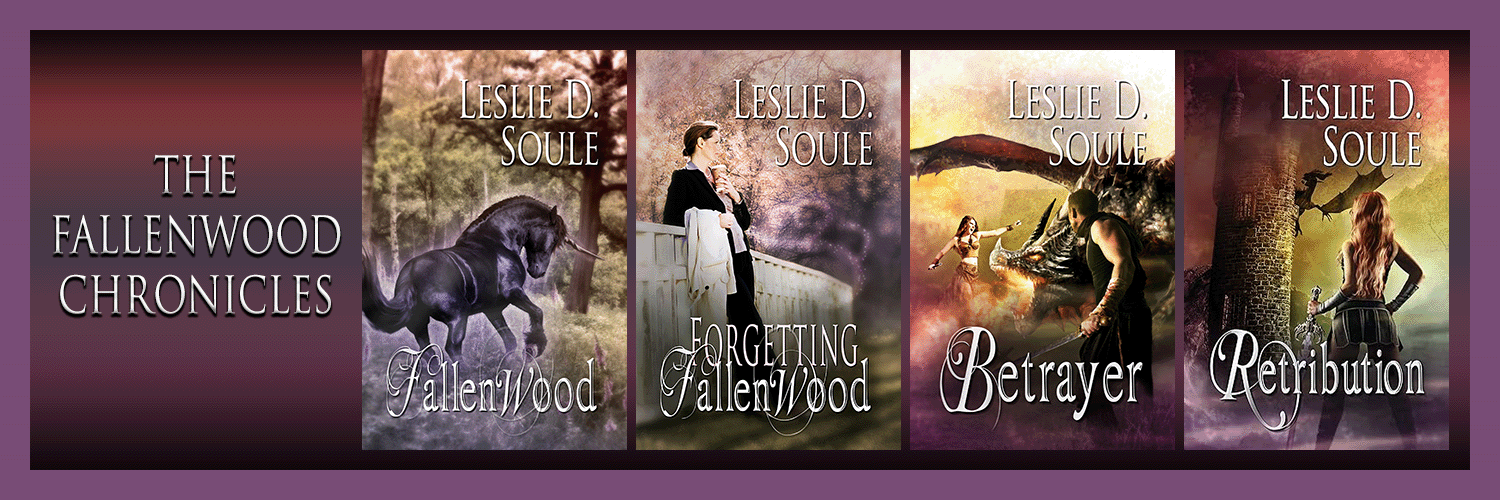
The Fallenwood Chronicles is the ongoing story of Ash Kensington, a young woman who finds herself transported into a fantasy world, where she must take up arms in a battle of Good vs. Evil, against the Dark Lord Malegaunt. Tragedy strikes her life in the real world, but she finds friends in Fallenwood, like her mentor Will Everett, a talking cat named Greymalkin, and a court jester named Terces. Working together, they battle against the odds as Ash faces attacks from the world and from within. Eventually Ash finds the strength within herself, to attempt the fight against Malegaunt, against overwhelming odds, come what may
Excerpt:
Her heart raced and she breathed slowly, trying to calm her frazzled nerves. Glancing around, she wondered how far off the road she’d wandered. She knew it had been midday when she’d started running, and now looking up into the star-filled sky, it had to be late into the night. A rush of air greeted her the moment she reached this strange part of the forest, before her eyes had temporarily forsaken her. The wind whipped around her from all sides. She backed away from where she stood, and the wind felt like it was whooshing up from a precipice. Ashley paused to allow her eyes to adjust to the dark. When her sight returned, she realized that she was standing nowhere near a cliff—it was just an unfamiliar area of forest. Suddenly, a ball of fire hurtled overhead in an arc toward her. Her mind screamed at her to run, but she found that her legs wouldn’t move. The flaming orb continued its descent, burrowing itself into the soft ground only inches away from Ashley’s boots. Two men rushed toward her, arguing all the while as Ashley stood immobilized. Her bones were in revolt. Her brain scrambled for an alias to give out to the men if they asked, but she could only come up with Ash, because she was looking at the little pile of soot at her boots. “Deflected,” the man in the lead announced.
Guest post:
Advice For New Writers
So when I first set about trying to get my work published, one of the resources that was suggested to me, was/is a volume known as the Writer’s Market. This book is published every year, and contains information on the current publishers who are looking for new material, their requirements, and submission guidelines. Sometimes, you can find a copy of the Writer’s Market in your local library if you’re short on cash, or at a bookstore, where you can sit down and copy down the information on paper or take some snapshots with your phone.
A free resource that I’ve found, that’s great for submitting items like short stories in particular, is a site called Submittable. It’s free to start an account, and you can find places to submit to. Some publications on Submittable do require a fee of a few dollars, to keep them going. It’s fun to see which items get accepted via Submittable, and you may be able to find some publications that you really like, there, that you might not have found otherwise. For example, the Submittable platform is how I found Nat 1 publishing, which has published several of my works.
Also, it may be helpful to get yourself a tool for overcoming that pesky thing called writer’s block. For that, I’ve found that this thing called the Writer’s Toolbox – find it HERE on Amazon – does the job of combatting writer’s block, nicely.
And the last bit of advice I’d give to a new writer is to hold onto as much of your writing as possible and not throw things away, even if you think they’re terrible, because you can always take a piece you’ve written and re-work it later. You’ll be glad you held onto your stuff, years down the road.
Author Bio:
Leslie D. Soule received her M.A. in English from National University. She is a scholar, artist, citizen journalist, and martial artist. She has been an established writer for a decade, and has novels published by Melange Books, Terror House Press, Gypsy Shadow Publishing, and Nat 1 Publishing. The Fallenwood Chronicles is her 4-book fantasy series and features the novels Fallenwood, Forgetting Fallenwood, Betrayer, and Retribution.
Good afternoon, squiders! Hope your week is going well! I finished a new chapter on my edit and the next chapter is rolling along, so I’m feeling pretty good.
WriYe’s April Blog prompt is: What author do you admire the most? Why?
This is an interesting question. What do we consider admiration?
I have authors that I’ll pick up any new book they put out: Donna Andrews, whenever she puts out a new Meg Langslow mystery (normally twice a year). Stuart Turton. TJ Klune.
There’s authors who put out a ton of books, like Lindsay Buroker. Authors who self-published but got picked up by a Big 5 publisher and became bestsellers, like Andy Weir or Travis Baldree.
Then there’s authors who were such powerhouses that we keep reading them all these years later, like Agatha Christie or Jane Austen. Or authors who have the ability to create a world so fantastically real that you understand its rules even though they’re all made-up, like Tolkien.
Each of these authors has skills that I admire. They have the ability to create immersive stories that call you back time and time again, or they weave plot twists that you never see coming, or they have a work ethic that I would kill for half of.
How do you pick just one? How do you look at all the stories out there, all the authors, and say, Yes, this is the one. This is my favorite.
I certainly can’t.
I tend to keep a Top 5 list of my favorite books, which goes through permutations. It’s typically The Phantom Tollboth (Norton Juster), Pride and Prejudice (Jane Austen), The Return of the King (JRR Tolkien), Agnes and the Hitman (Jennifer Crusie/Bob Mayer), and then the fifth one varies. Maybe The 7 1/2 Deaths of Evelyn Hardcastle (Stuart Turton) right now. Truly impressive plotting on that one.
But yeah–author I must admire? It really depends on the context, and how I’m feeling, and what books I’ve read recently.
And having written several novels myself–kudos to everyone who gets one done and out into the world. It’s not an easy task.
Hey ho, everybody! I set a video game goal for the year, to make it through my large catalogue of unplayed Steam games and at least categorize them. As I mentioned last time, this is manifesting as me picking out three games a month and poking them.
At the suggestion of a friend, this morning I made a “Long Game” category for games that take 20-40+ hours to beat, so instead of trying to beat them as part of this, I can just take note and come back to them later.
(The other categories are:
Beat the Game But Would Play Again (self explanatory)
Beat the Game! (for games I have beaten and probably will not play again)
Fun! (games that can be played on and off, and that I want to do so)
Idle Games (idle miners and clickers)
Online Multiplayer (self-explanatory)
Tried but Eh (didn’t like or were frustrating for whatever reason)
Uncategorized)
March
For March I selected Garden Story (a continuation from February, as it’s a longer game, 40 hours or so), Stardew Valley (which I bought cuz it was half price and everyone seems to love it), and Alba: A Wildlife Story.
Alba: A Wildlife Story
I definitely picked up Alba as part of a bundle of games. I super enjoyed this one. It took me about four hours to beat, which seems to be the sweet spot, honestly. Not too long where I can get distracted by other things, not too short to not be worth it. I finished it over the course of about four days. It’s part “find and photograph animal” game, part pro-environmental messaging, part puzzle game. The story was pretty decent too. I actually teared up a bit at the end. (Category: Beat the Game!)
Garden Story
I did play more of this game, but I didn’t get terribly far. Garden Story is an adventure game where you play a grape named Concord and attempt to save the Grove from the rot that’s eating it. It’s fun, but I have a hard time focusing on long games in any sort of consistent manner. (Category: Long Game)
Stardew Valley
Everyone knows about Stardew Valley, right? It’s not really my type of game (Farming sims have never really been my thing, though I did have SimFarm back in the day, to date myself) but it’s all right. There’s a LOT going on and a lot to keep track of, but I’ve played a bit by myself and some with a friend, who is nicely explaining everything to me, which has been a HUGE help. I don’t know if I would have figured out some aspects of the game on my own. (Category: Long Game)
April
With both Garden Story and Stardew Valley being massive, I specifically picked shorter games for this month. (Thank goodness for the ability to search for average play time.) So for April I have Cleo: A Pirate’s Tale, Princess Farmer, and Here Comes Niko!
Princess Farmer
I picked up Princess Farmer in a bundle as well (and I remember it distinctly, because they didn’t have enough keys for this game in particular and I had to keep checking back. The rest of the games were fine). It wasn’t one of the games I was looking forward to in said bundle, but I actually really enjoyed it. It took me about seven hours to get through the storyline the first time, and there’s a couple of different modes that I’d like to give a try, so this one gets moved into the Fun! category.
Here Comes Niko!
This is also probably a bundle game. In Here Comes Niko!, you’re working as a professional friend, and it’s a combination of a platformer and a puzzle game as you solve problems for people on a variety of islands. I found it extremely frustrating. The controls are very sensitive, and the 3D environment makes a lot of the platforming aspects just too difficult for me. After I’d given up, the smaller, mobile one tried for an HOUR and a HALF to catch five fish for one guy, and couldn’t manage it either. (Category: Tried but Eh)
Cleo: A Pirate’s Tale
I kickstarted this game! Also it’s on SALE for $3 right now, so you should go and grab it. This is an old-school adventure game like the old LucasArts games (one of my favorite video game genres). I’ve only played the intro so far, but I’m really enjoying it. Highly recommend. (Not categorized yet, as I hope to beat it.)
I may go back to A Short Hike! if I have time later in the month–I only played it for about 15 minutes back in February, and I need to give it more of a go to either beat it or move it in a category of some sort.
Have you played any of these games, Squiders? What are your favorite types of games?
Good evening, squiders! How’s your April going? Mine is full of volunteer commitments, but luckily I’ve got the biggest of those behind me at this point. Still more, but the stressful ones are done.
So, as we all know, for spring break, I was like, oh, I’ll switch over to Deep and Blue since I’m not going to have as much focusing time, and get that done, and then when the break is over I’ll head back to the Book 1 revision.
And here we are, three and a half weeks later, and we are still on Deep and Blue. I think I’m done now–I came up with the fourth iteration of the book description tonight, which is the final outstanding thing, and I’ve had a couple people look at it, and I’m declaring it Good Enough.
(I posted the cover earlier, but here it is again, just cuz.)
I should know by now that my “oh, I’ll just work on this for this short time period” plans almost always take longer than expected. I mean, not always–sometimes I can take a week off of a big project to do a smaller one–but more often than not. Am I bad at estimating how much time something is going to take? Sometimes. Sometimes, like this particular case, where I’m waiting on feedback, it’s out of my control.
(I did write a side scene on Book 1–basically a behind-the-scenes of what other characters are doing. It won’t ever go into the book but it helps me to explore other characters’ motivations so I know how they’ll react to things or why they’re doing things the way they are. Also read over a couple of other ones that I’d written earlier.)
Anyway, I am declaring Deep and Blue ready to go, and tomorrow we’ll read back over Book 1 thus far (to remind myself where I am and what I’m doing) and then dig into the meat of Act 3, where new chapters are needed and a surprising amount of work needs to be done. Yay.
Also, I need to edit chapters 20-22 from the critique marathon feedback and send them out to my in-person critique group. Probably do that first.
Here’s the final book description for Deep and Blue:
When the surface became unlivable, humanity retreated under the waves.
In the underwater city of Haven, oceanographer Kaeri has been given her first assignment: a coveted spot on the team working to return the people of Haven to the surface.
No friends. No family. An opportunity to earn her place.
Not quite ostracized but never welcomed, Kaeri has never belonged. Something about her parents, though no one has ever explained what. And though she has become a respected scientist, people still shy away from her in the corridors, their conversations dying away.
The new job is a chance to change all that. But before she can begin, strange things start happening. Shadows flit across the security cameras. Doors to airlocks and power generators unlock themselves. And people, across the city, are being attacked by something invisible.
If Kaeri can save Haven from these mysteries, people will have to accept her. But digging into Haven’s secrets may bring answers that were better left alone.
~*~*~*~
So. Refocusing. Moving forward. Deep breaths all around.
Good morning, squiders! I’ve got a book for you today! You guys know I love a good Gothic, and this one sounds great! Give it a look!
Haunted Historical Mystery Series, Book 3
Paranormal Thriller
Date Published: February 25, 2024
A blizzard rips through the Black Hills of South Dakota, as journalist
Rachael embarks on a journey to Hawthorne House, a remote inn located deep
in the frigid wilderness. As the storm rages on, Rachael finds herself
caught in a gripping tale of mystery and intrigue, unsure of what lies ahead
in the enigmatic world of the treacherous snow-covered landscape and the
sinister forces that lurk within Hawthorn House. The icy snowstorm blurs the
lines between reality and imagination as Rachael uncovers secrets and
revelations that challenge her perception of the caretaker and the true
nature of Hawthorn House.
About the Author
Regina endeavors to take her readers on a journey around the United States
to be fascinated by our country’s history in a series of chilling books she
hopes you will love. She blends a captivating blend of mystery, historical
intrigue, and paranormal elements, her gripping novels, weaving together
tales of secrets and revelations that span centuries. Her stories often
delved into the hidden depths of history, uncovering long-forgotten
mysteries and unsolved crimes that haunted the past. It was the paranormal
twists that set Regina’s work apart, adding an extra layer of intrigue and
suspense that kept readers eagerly turning the pages until the very end. She
continues to explore the darker corners of the human experience through her
captivating storytelling.
Thank you for reading and please leave a review. Her next book will be
coming out in the summer of 2024, The Haunting of York Hall. Any questions
or comments? Please visit her wheebsite at reginawixon.com. or follow her on
Facebook where she will keep you updated on upcoming books. Questions?
Please email her at regina.wixon@gmail.com – She’ll be happy to hear
from you!
Good afternoon, squiders! Sorry for abandoning you all week! I wish I had a good excuse but I don’t.
I did finish the final edit for Deep and Blue today. It has a publication date now (May 1) and is coming along–just needs to be formatted and the book description needs some tweaking.
(I gotta say, working on marketing material is always so frustrating. I showed the book description to some friends to be like, hey, would you pick up this book? And they generally were like, yeah, it sounds cool! Good job! And then I posted it to a writing community, who pulled it apart and hated all of it. Probably the solution is somewhere in the middle, but it is very disconcerting to have such varied reactions, and I do sometimes wonder if writing communities feel the need to fix things that are perhaps okay as is.)
(Or maybe they know what they’re talking about! Who knows!)
(Anyway.)
(I just want all the Deep and Blue stuff done so I can go back to Book 1! Also I changed a character’s name in the middle and no one, including me, noticed and it was published serially like that, so that’s embarrassing.)
I talked a few weeks ago about potentially going to Pikes Peak Writers’ Conference to network and so forth, and ended up talking myself completely out of it through writing said blog post. I poked around a bit more at writers’ conferences before deciding that they really weren’t what I was looking for (and going farther afield didn’t fix the networking issue), and then I spent some time looking at writing residencies.
Writing residencies sound great, in theory! In some cases you pay, and in others they pay you, and you go somewhere for anywhere for a week to a few months, and all you do is write (and in some cases, maybe teach a class or prepare a piece for wherever you’re staying).
But, of course, I have the small, mobile ones (though at least the bigger, mobile one is not so small anymore). I did find a few retreats that do allow you to bring your whole family (including one only a few hours away!) but arguably if you bring your kids you’re not getting the whole immersive experience that a residency advertises. But, yeah, the ability to just go off on my own for a while without the rest of the family is not really a thing, at the moment.
Also, in almost all cases (but especially for ones where you stay for free or they pay you), there is an application process. And I just can’t see most of these places digging through all these applicants and being, “Ah, yes, this fantasy/science fiction/horror writer is providing the right level of prominence and art that we look for in our program.”
(And then I looked around to see if there was anything specifically for speculative fiction, and aside from fancy workshop programs like Clarion or Odyssey, the answer was no, and those are also quite long and very expensive, and there is an application process for those as well, and you have to apply months and months and months in advance. So yeah.)
So I shelved that idea.
And then I moved onto writing retreats. A retreat is not unlike a residency, where there is an amount of time dedicated to writing. But unlike (some) residencies, there are other writers there, and they tend to be shorter, normally a few days to a week.
I think this is the right solution for right now. It has the networking, it has the writing, and hopefully it will be sort of relaxing. (Plus they will feed me, always a plus.)
I found two happening relatively nearby, happening in the next two months. I did some research and picked one, for the end of May.
Of course, now my spouse is saying he might need to take a business trip over those days.
Sigh.
Anyway, how are you, squiders? Done a writing retreat before? (Or a residency, for that matter?)



 Where Landsquid Fear to Tread